Behind London Pigment
Lucy Mayes

Lucy Mayes (b. Birmingham, England, 1991) is an artist and pigment maker based at her public studio and shop in Portsmouth's historic Hotwalls Studios. Her practice centres on the pedagogy of pigment making, through which she explores the material, historical and cultural significance of colour. Mayes received a BFA from the Ruskin School of Art, University of Oxford, in 2014, followed by an MFA from the Royal College of Art in 2016. It was during her studies that her enduring interest in colour theory, pigment processing and paint making first took root, laying the foundations for the material-led practice that has since become central to her work.
Mayes teaches extensively, both online through platforms such as Plants & Colour and in person for institutions including West Dean College and the V&A. Alongside her educational work, she produces handcrafted pigments under the name London Pigment, develops bespoke pigment collections for artists and organisations, exhibits painting and pigment-based installations, and works as a consultant on projects involving natural colour, material research and pigment production.
Lucy is a committed advocate for the craft of pigment making. In 2023, she successfully secured its inclusion on the Heritage Crafts Red List of Endangered Crafts, helping to raise awareness of the need to preserve this specialist skill allowing others to benefit from future grants to learn the craft. That same year, she represented the craft at the Bovey Tracey Craft Festival and was awarded a sustainability grant to further reduce the environmental impact of her pigment production, supporting the development of a more environmentally responsible practice.
Lucy has been making pigments and paints since 2018 and has taught the craft since 2020. Her practice has been shaped by a generous community of artists, makers and researchers dedicated to the preservation and advancement of natural colour traditions. She learned the foundations of pigment and paint making under the mentorship of Keith Edwards and has continued to deepen her knowledge through the guidance, collaboration and exchange of ideas with practitioners including Melonie Ancheta, Caroline Ross, Heidi Gustafson, Jo Volley, Ruth Siddall and Magnus Sigurdsson. She also recognises the wider community of natural materials specialists—particularly the teaching faculty of Plants & Colour and the board of Pigments Revealed International—whose collective knowledge and commitment continue to inspire and inform her work.
Mayes is particularly interested in the deep and ancient lineage of pigment-making traditions. She approaches this knowledge with respect and gratitude, acknowledging the influence of Indigenous pigment practices on her understanding of materials, place and colour. She is especially indebted to the generosity of Māori practitioners, including the Kauae Raro Research Collective, and Pacific Northwest Indigenous artist and educator Melonie Ancheta, whose work and knowledge have profoundly informed her own approach to pigment making.
Mayes is also deeply indebted to L. Cornelissen & Son, whose support provided an invaluable period of incubation early in her career. There, she was given the time, resources and encouragement to immerse herself in the study of pigments, developing into the company's pigment specialist. Working as a pigment consultant and product developer, she was responsible for researching and expanding Cornelissen's historic pigment archive, an experience that laid the foundations for her subsequent practice as both a maker and educator.
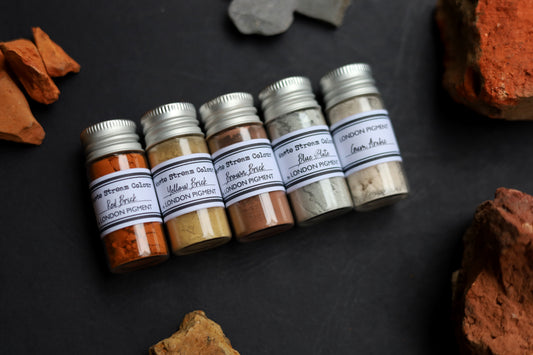
Following the award of a Heritage Crafts Sustainability Grant in 2023, Mayes has committed her practice to developing low-impact methods of pigment production, with a particular focus on creating colour from waste streams and renewable resources. Through her work, she investigates the environmental, cultural and material potential of recycled pigments, transforming urban waste into colour as a means of documenting contemporary lived experience.
Her practice is centred on the use of unexpected, overlooked and often highly local raw materials. Pigments made from stripped copper wire recovered from burnt-out mopeds, soot and ash from park fires, demolition rubble and other urban detritus become records of place, labour and human activity. By working with materials that have already been shaped by use and invested with social and economic value, Mayes creates pigments that carry layered narratives of history, industry and everyday life.
Alongside this interest in waste-derived colour, Mayes maintains an ongoing practice of collecting and processing British earth pigments. While she values the rich geological heritage of natural earth colours, she is increasingly interested in the creative and ethical possibilities of transforming discarded materials into new pigments. As naturally occurring mineral resources become increasingly finite, particularly in contrast to the dominance of industrially manufactured synthetic colour, she sees the recovery and reuse of existing materials as an important strategy for the future of sustainable pigment production.
Through London Pigment, Mayes aims to expand the availability of recycled pigments, making them accessible to artists, educators and cultural institutions on a wider scale. Her research into British earth pigments has taken her across the country, resulting in a continually growing archive of historical and contemporary pigment sources. She is currently working on her second book, which celebrates the life and legacy of her mentor, Keith Edwards, and his enduring contribution to the craft of pigment making.

Studio Still Life, London, 2021
Waste Stream Colour Products
-
Waste Stream Watercolour Complete Set
Regular price From £70.00 GBPRegular priceUnit price per -
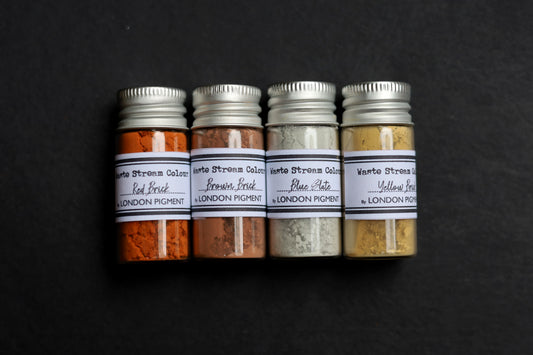
Waste Stream Colour Full Set
Regular price From £60.00 GBPRegular priceUnit price per -
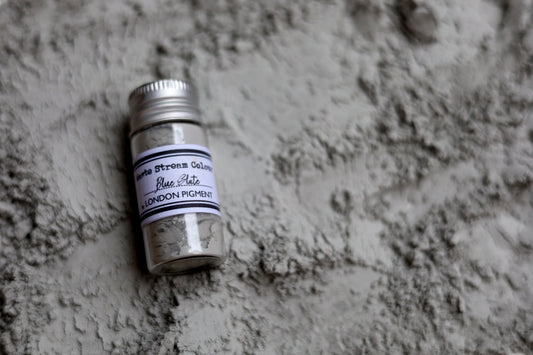
Blue Slate Pigment
Regular price £15.00 GBPRegular priceUnit price per -
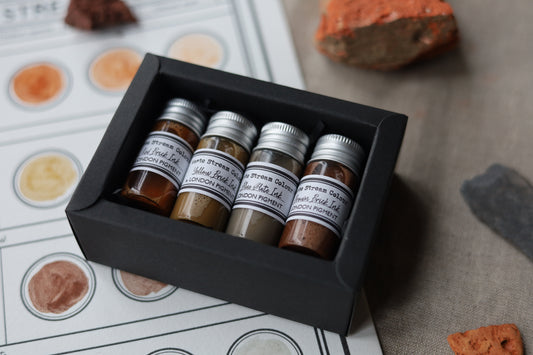
Waste Stream Colours Ink Set
Regular price £38.00 GBPRegular priceUnit price per