Cornwall Museum Commission
Bespoke Pigment Display & emulsion paint for the Mineral Gallery at Cornwall Museum
In 2023, Lucy was commissioned by architects Wignall & Moore to develop a bespoke paint colour for the walls, a complementary palette for the architectural detailing, and a permanent pigment display celebrating Cornwall’s rich mineral heritage.
Drawing inspiration from the museum’s mineral archive, Lucy undertook extensive research and visited three historic mining locations across Cornwall to collect mineral samples. These materials informed the creation of a unique pigment blend for the paint and helped shape a compelling narrative for the permanent display, connecting the building’s colours to the region’s geological and mining history.
NOTE: Visit the individual pages for the sites for this project for more detailed information.

The Mineral Gallery at Cornwall Museum after its 2023 transformation.
Globally important mineral collection
The Mineral Gallery collection came to Cornwall Museum and Art Gallery through a number of donations from 1893 onwards. The acquisition of the Philip Rashleigh Collection in 1903 comprised 3,000 specimens, complete with his detailed catalogues and correspondences and brought important specimens into the museum’s care.
The Mineral Gallery today is home to a number of important specimens; the world’s largest known crystal of Liroconite, found in 1808 in Wheal Gorland, Gwennap; Cassiterite, the main tin ore and what started Cornwall’s mining heritage; Blister copper, which became a huge generator of wealth; and over 12,000 other specimens of rock, mineral, crystal and mining artefacts.

The commissioned permanent pigment display showcasing Cornwall's mineral pigments.
Cornwall Museum's archive
Lucy explored the museum’s research collection, bequeathed by Lesley Nash, a Cornish mineral dealer and collector active in the late 20th century. She carefully examined 60 boxes of lower-grade mineral specimens, previously offered for sale in the museum shop, to identify materials suitable for processing into natural pigments. Among her discoveries were specimens of azurite and malachite from County Galway, Ireland, which could be transformed into vibrant blue and green pigments. The azurite & malachite pigments were produced from these samples and used to paint the dentals above the door to the mineral gallery. She hand mixed these pigments with binders supplied by Rose Of Jericho Ltd to Crete breathable heritage paints on the architectural plasterwork.

Raw azurite/malachite from the museum's research collection, bequeathed by Lesley Nash. This sample contains many impurities such as iron oxide.

Azurite, malachite & iron oxide pigments alongside the raw untreated rock containing the minerals from Ireland.

Detail of Azurite, malachite & iron oxide pigments. (above)
Cornish Metals
Lucy visited South Crofty Mine, in Redruth where she had permission to collect granite & kaolin, alongside iron oxide stained kaolin. This was added to the paint to help with pigment adhesion, dispersion and viscosity.

Cornish Lithium
Lucy visited the TreLith Processing site, St Dennis, Cornwall where she had permission to collect hydrous iron oxide, a waste product from the processing of waste mine water. This was added to the paint to create a warm earthy tone to its colour.
Delabole Slate
Lucy was supplied with slate powder and raw materials from Delabole slate. These materials were further refined and added to the wall paint to give the paint body and act as a bulking agent.
The Wall Paint
The deep green-blue-grey interior emulsion was developed using a bespoke blend of pigments inspired by Cornwall’s rich mining heritage. At its foundation was a mixture of blue-grey slate pigment and kaolin clay, which gave the paint its distinctive viscosity, flow and opacity. Synthetic ultramarine blue was then introduced to create a subtle blue undertone, balanced with iron oxide to soften its chromatic intensity and achieve a more muted, nuanced colour.
The resulting dry pigment blend was sent to Rose of Jericho Ltd, where it was combined with a specially formulated, breathable casein binder to produce a sustainable paint with a rich, velvety matt finish.
The Pigment Display
Drawing on her visits to historic mining sites and research into the museum’s mineral collection, Lucy began developing the narrative for the permanent pigment display. Through further research with Imerys Minerals Ltd, a company with mining operations in Cornwall, she uncovered the pivotal role of Cornish kaolin in the early synthesis of ultramarine blue.
In 1826, French chemists succeeded in synthesising ultramarine, a breakthrough that offered an affordable alternative to the precious blue pigment traditionally derived from lapis lazuli. The discovery was recognised with a prize from the French government. Central to this process was Cornish kaolin, prized for its exceptional purity, which was combined with sulphur, carbon, rosin and soda ash to produce the brilliant blue pigment.
This remarkable connection between Cornwall’s mineral heritage and the history of colour became a central thread in the display. The story of synthetic ultramarine is presented alongside blue azurite pigment processed from specimens in the museum’s archive, exploring the relationship between these two pigments and their use in artists’ paints, from Renaissance easel painting through to the 19th century.

The infographics of the pigment display weaving the colour narrative between Cornish mining, historical blue pigments and the synthesise of ultramarine blue.

The pigment display including samples of the component parts in synthetic ultramarine production and pigments made by Lucy including Azurite, Malachite and raw ultramarine blue pigment cakes.

Detail of the azurite, malachite and iron oxide pigments that feature in the pigment display. (above)
More on the mineral gallery below:
Waste Stream Colour Products
-
Waste Stream Watercolour Complete Set
Regular price From £70.00 GBPRegular priceUnit price per -
Waste Stream Colour Full Set
Regular price From £60.00 GBPRegular priceUnit price per -
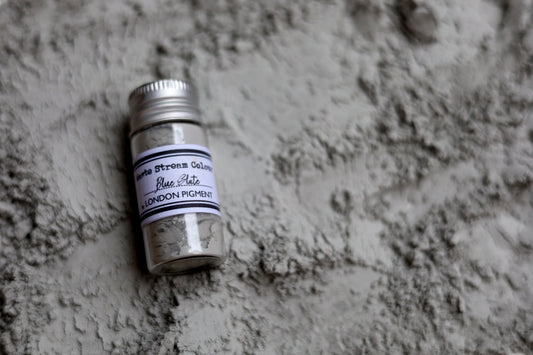
Blue Slate Pigment
Regular price £15.00 GBPRegular priceUnit price per -
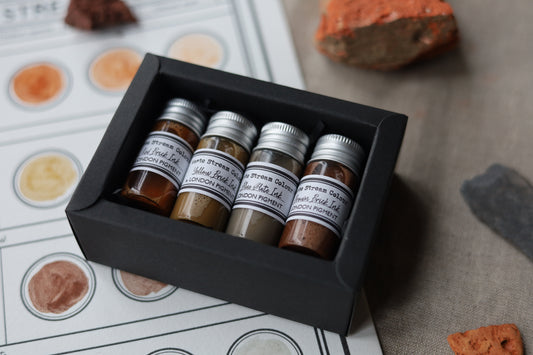
Waste Stream Colours Ink Set
Regular price £38.00 GBPRegular priceUnit price per