History of Pigment Making
Key Dates
Here is an outline of key periods in pigment & paint manufacture throughout time.
c. 100,000 BCE and earlier – Prehistoric Pigments
Early processing of natural earth pigments for body decoration, ritual practices and mark-making, followed by their extensive use in prehistoric cave and rock painting.
Key pigments: Red ochre (hematite), yellow ochre (goethite), manganese black, charcoal black and white clay.

Ochre-processing shell
An abalone shell used as a container for an ochre-rich mixture. The shells were discovered alongside grinding stones and other processing tools.
Source: Christopher Henshilwood and colleagues, Science (2011).
c. 3000–500 BCE – Ancient Egyptian and Mesopotamian Painting
Development of manufactured pigments, particularly Egyptian blue. Pigments were widely used by scribes, artisans and painters for tomb murals, temple decoration, papyrus illustrations, sculpture and decorated objects.
Key pigments: Egyptian blue, malachite green, red and yellow ochres, orpiment yellow, carbon black, gypsum white and calcite white.

A shell used as a painter's palette, preserving traces of blue, red and brown pigments, alongside a brush made from bundled plant fibres. This provides evidence of how artists prepared and applied their colours.
Source: Brooklyn Museum, Egyptian collection.
500 BCE–500 CE – Classical Antiquity: Greek and Roman Painting
Expansion of mineral pigment production and trade, with fresco and wall painting flourishing throughout the Greek and Roman worlds. Pigments were also used in encaustic painting, panel portraits, manuscripts and architectural decoration.
Key pigments: Cinnabar and vermilion red, red lead, Egyptian blue, azurite blue, malachite green, verdigris, green earth, yellow and red ochres, lead white and carbon black.

Roman pigments preserved in ceramic vessels, Pompeii, 1st century CE. Collection of the National
Archaeological Museum of Naples. Photograph © Photographic Archive, National Archaeological Museum of Naples.
500–1400 – Medieval Manuscripts and Sacred Painting
The flourishing of illuminated manuscripts, particularly between the 9th and 14th centuries, saw specialist pigment preparation by scribes and illuminators in monastic and secular workshops. Pigments were also used for religious panel paintings, icons and church murals. Iron gall ink became a dominant European writing medium.
Key pigments and inks: Natural ultramarine (lapis lazuli), azurite blue, malachite green, verdigris, vermilion red, red lead, orpiment yellow, lead white, indigo, organic lake pigments (madder and kermes), carbon black and iron gall ink.

Artist Mixing Colours, c. 1360–1375. Illuminated initial from Omne Bonum, compiled by James le Palmer.
British Library, Royal MS 6 E VI, fol. 329. Public Domain.
1400–1600 – Renaissance Fresco, Tempera and Oil Painting
Refinement of pigment grinding, washing, extraction and preparation during the height of Italian Renaissance fresco painting and the expansion of oil painting in Northern Europe. Artists developed increasingly sophisticated techniques for layering and combining pigments, with some colours applied to dry plaster rather than directly into wet fresco.
Key pigments: Natural ultramarine, azurite blue, smalt blue, verdigris, malachite green, green earth, lead-tin yellow, vermilion red, red and yellow ochres, lead white, madder lake and carbon black.
 A medieval workshop scene showing an artist painting while an assistant grinds blue pigment. It illustrates how colour preparation and painting were closely connected, particularly in manuscript illumination.
Source: Web Gallery of Art, Italian secular manuscripts, 1401–1450.
1600–1700 – Baroque Painting and the Expansion of Colour Trade
Growth of professional colourmen and international pigment trade alongside the flourishing of oil painting, portraiture, still life and decorative arts. Imported organic colourants expanded artists' palettes, while traditional mineral pigments remained essential.
Key pigments: Natural ultramarine, azurite, smalt blue, lead white, lead-tin yellow, Naples yellow, vermilion, red ochre, green earth, verdigris, indigo, cochineal carmine and madder lake.

Engraving of Van Eyck's workshop, detail, Philips Galle workshop after Jan van der Straet, c. 1593 - c. 1598
Source: The Metropolitan Museum of Art, accession 2009.193. Public domain
1700–1820s – The Emergence of Modern Synthetic Pigments
Advances in chemistry introduced new manufactured colours, transforming the palettes available to painters, printmakers and decorative artists. Prussian blue, discovered around 1704, marked a major breakthrough in modern pigment chemistry.
Key pigments: Prussian blue, cobalt blue, chrome yellow, Scheele's green, emerald green, Naples yellow and traditional lead white.

A preserved Prussian blue pigment sample alongside colour swatches showing the pigment in different media. Although the sample dates from 1927, it documents the material first discovered around 1704.
Source: Museum of Fine Arts, Boston — CAMEO Conservation and Art Materials Encyclopedia.
1820s–1900 – Industrialisation and the Expansion of Artists' Colours
The development of synthetic ultramarine in the 1820s provided an affordable alternative to natural lapis lazuli. Mechanised pigment production, synthetic substitutes and commercially prepared paints transformed artists' materials. Portable paint tubes helped support the growth of outdoor landscape painting and Impressionism.
Key pigments: Synthetic ultramarine, cobalt blue, cerulean blue, chrome yellow, cadmium yellow, viridian green, emerald green, zinc white, synthetic alizarin crimson and synthetic iron oxides.

Machinery for grinding pigments. 1824
A coloured engraving illustrating several mechanical pigment mills and a worker grinding colour beneath a ventilation hood. It captures the transition from hand grinding to increasingly mechanised paint manufacture.
Source: John Pass, Pigment, 1824, Wellcome Collection.
1900–1970 – Modern Pigment Chemistry and Industrial Colour
Development of synthetic inorganic and organic pigments with improved colour consistency, tinting strength and lightfastness. These materials transformed modern painting, industrial coatings, printing inks, plastics and commercial colour production.
Key pigments: Titanium white, cadmium red, phthalocyanine blue and green, Hansa yellow, quinacridone red and violet, perylene red, synthetic iron oxides and carbon black.

Pigment milling at Mason Color Works
An archive photograph showing a worker beside large pigment-grinding mills. It illustrates how mechanised processing enabled the production of finely ground, consistent colours for industrial and ceramic applications.
Source: Mason Color Works, company heritage archive.
1970s–Present – Contemporary Pigment Innovation and Traditional Revival
Renewed interest in traditional pigment-making, natural earth colours, locally sourced minerals and sustainable paint production, alongside advances in engineered pigment particles, structural colour, interference pigments and optical coatings. Contemporary artists and material researchers increasingly explore both historical colour-making processes and new technologies.
Key pigments and colour materials: Natural ochres, mineral earth pigments, plant-based lakes, synthetic iron oxides, quinacridones, phthalocyanines, synthetic mica-based interference pigments, pearlescent pigments and structurally coloured materials.

Image source: Natural Earth Pigments, Heidi Gustafson, Early Futures. Photograph published in Ochre Earth Pigments with Heidi Gustafson of Early Futures, Gist Yarn, Episode 91.
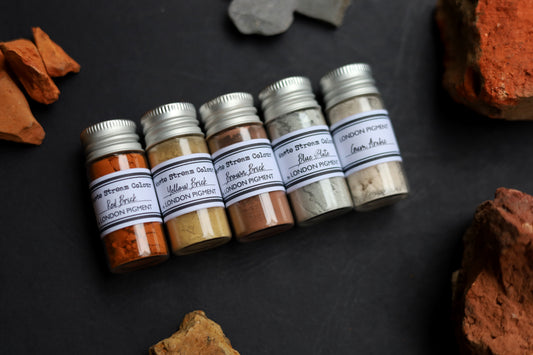
Waste Stream Colour Products
-
Waste Stream Watercolour Complete Set
Regular price From £70.00 GBPRegular priceUnit price per -
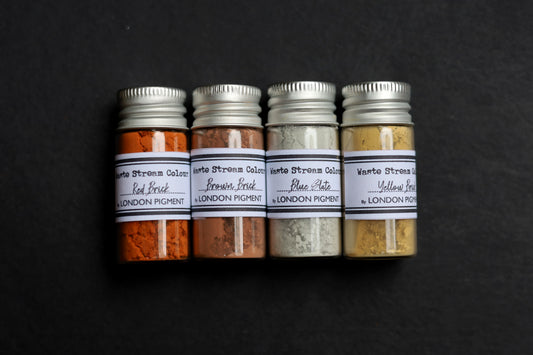
Waste Stream Colour Full Set
Regular price From £60.00 GBPRegular priceUnit price per -
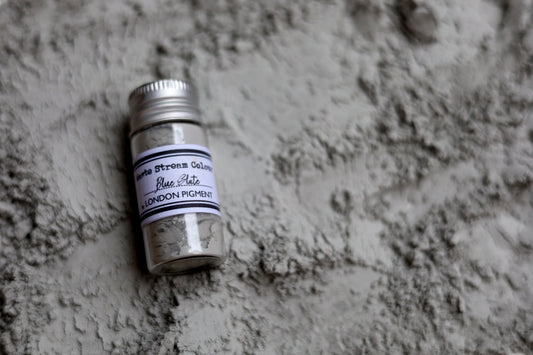
Blue Slate Pigment
Regular price £15.00 GBPRegular priceUnit price per -
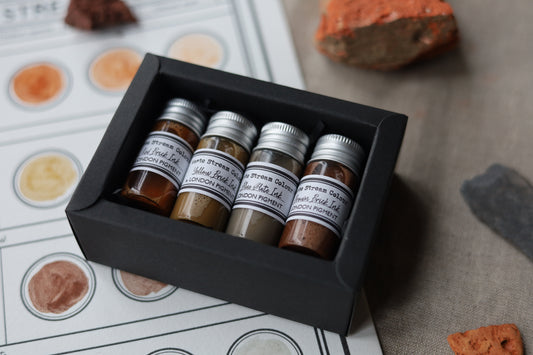
Waste Stream Colours Ink Set
Regular price £38.00 GBPRegular priceUnit price per