Heritage Crafts
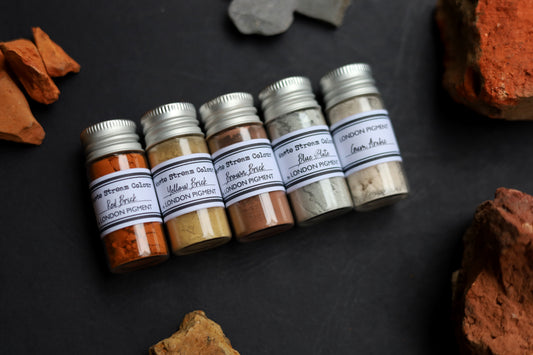
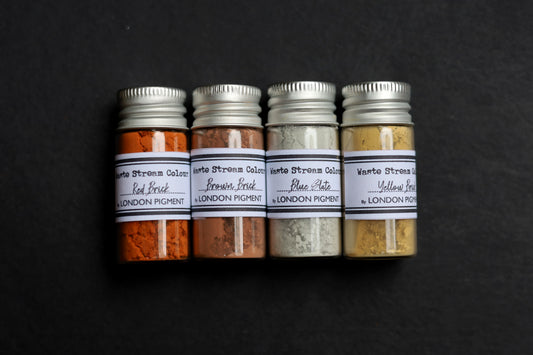
Pigment making is now officially recognised as an Endangered Craft on the UK Heritage Crafts Red List of Endangered Crafts. It was first added to the Red List in 2023 and remains classified as Endangered in the latest 2025 edition. Mayes initiated the application for the inclusion of pigment making on the Heritage Crafts Red List of Endangered Crafts in 2022 and continued to champion its recognition until it was successfully added in 2023. She undertook the research and evidence-gathering that underpins the listing, compiling the historical and contemporary documentation that now forms the publicly available resource on the Heritage Crafts website. To see how this work has been realised in practice, explore Mayes' 2024 Heritage Crafts Sustainability Grant project, which developed innovative low-impact pigments from construction waste and other reclaimed materials, demonstrating how endangered craft skills can contribute to more sustainable futures.
What makes this particularly interesting is that pigment making is one of the oldest material technologies in human history. For tens of thousands of years people have transformed earths, minerals, plants, insects and shells into colour for cave painting, manuscripts, easel painting, cosmetics, medicine and ritual. Yet the traditional knowledge of how to produce pigments by hand is now at risk.
Why is it endangered?
According to Heritage Crafts, there are only:
- around 7 professional pigment makers in the UK whose main income comes from making and teaching pigments;
- around 15 part-time professionals;
- no formal trainees;
- a small number of serious amateurs.
This means that most knowledge is passed on informally through workshops, apprenticeships, or individual research rather than through structured training.
Why has the craft declined?
Several factors have contributed:
- Industrialisation – By the late nineteenth century, large chemical companies could manufacture pigments more cheaply and consistently than individual colourmen.
- Loss of apprenticeship – Historically pigments were made in artists' workshops, apothecaries, colourmen's businesses and paint manufacturers. Those routes have largely disappeared.
- Global supply chains – Artists today buy finished pigments and paints rather than making them.
- Hidden knowledge – Much of the craft consists of tacit, embodied knowledge: learning by touch, sound and experience rather than from written recipes.
- Economic pressures – Hand-made pigments are labour intensive and occupy a niche market.
What makes pigment making unique?
Unlike simply grinding a coloured stone, traditional pigment making is a sophisticated refining process. It can involve:
- selecting suitable raw materials;
- crushing and grinding;
- washing;
- levigation (using water to separate particles by size);
- sieving;
- precipitation (for lake pigments);
- drying and storing.
The aim is to transform raw earth or mineral into a pigment with a consistent particle size, purity, colour strength and working properties.
Every stage depends on judgement developed through experience. Two people working from the same mineral can produce noticeably different pigments.
Why does it matter?
Pigment making is about much more than colour. It preserves knowledge of:
- geology and mineralogy;
- botany;
- chemistry;
- pharmacy and medicine;
- historical art techniques;
- sustainable use of natural materials;
- local landscapes and traditional resource gathering.
Historically, pigments moved between many different worlds. The same materials might be used by herbalists, apothecaries, illuminators, painters, dyers and physicians. Before specialist artists' colourmen emerged in the seventeenth and eighteenth centuries, artists often obtained pigments from apothecaries and spice merchants. This intertwining of medicine, craft and colour is one of the most fascinating aspects of pigment history.
A broader significance
Heritage Crafts describes endangered crafts as practices where there are still enough practitioners for the skills to survive, but only if knowledge is actively passed to the next generation. The Red List is intended as a call to action rather than an obituary.
Pigment making is an especially powerful example because it combines intangible cultural heritage—the embodied knowledge of the maker—with a material that has shaped human culture for over 100,000 years. Every hand-made pigment carries within it a chain of knowledge linking geology, landscape, chemistry, art and history, making the preservation of the craft about far more than simply producing colour.
Support the work of Heritage Crafts by becoming a member of the organisation and helping to safeguard the UK's living craft traditions. Your membership directly supports craftspeople, strengthens advocacy for endangered skills, and helps ensure that specialist knowledge is passed on to future generations.
 Above: Madder Lake pigment processing in Lucy's studio
Waste Stream Colour Products
-
Waste Stream Watercolour Complete Set
Regular price From £70.00 GBPRegular priceUnit price per -
Waste Stream Colour Full Set
Regular price From £60.00 GBPRegular priceUnit price per -
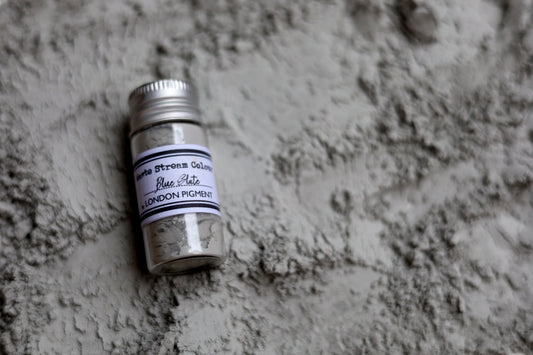
Blue Slate Pigment
Regular price £15.00 GBPRegular priceUnit price per -
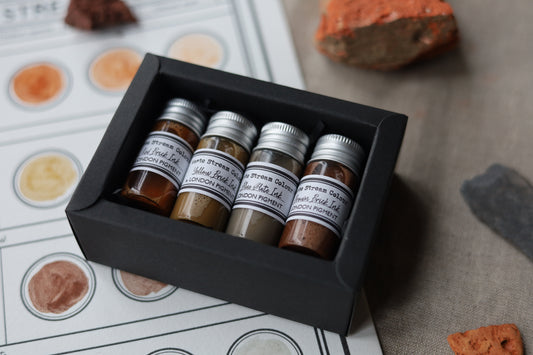
Waste Stream Colours Ink Set
Regular price £38.00 GBPRegular priceUnit price per